
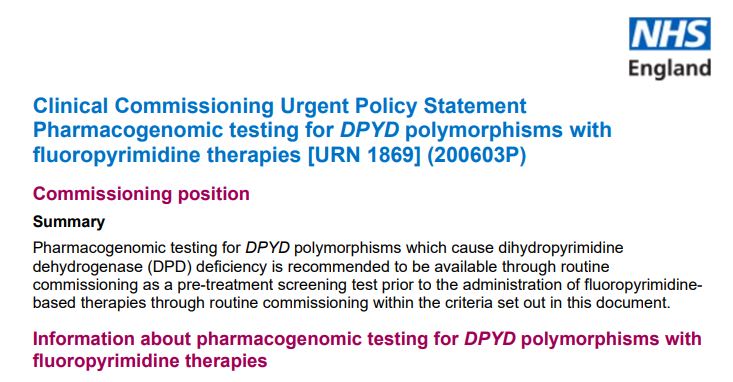
DPYD Testing Policy Published by NHS England and NHS Improvement
Dear all,
(Note – This statement is for England ONLY)
Please find an update from NHS England and NHS Improvement on:
- Clinical commissioning policy statement for pharmacogenomic testing for DPYD gene polymorphisms prior to initiation of fluoropyrimidine-based chemotherapy treatments
Dear stakeholder,
NHS England and NHS Improvement has published a clinical commissioning policy statement for pharmacogenomic testing for DPYD gene polymorphisms prior to initiation of fluoropyrimidine-based chemotherapy treatments. This clinical commissioning policy can be accessed here:
The policy outlines that all patients, prior to commencing treatment with a fluoropyrimidine based therapy (5-fluorouracil, capecitabine or tegafur) should be screened for four DPYD variants which have been associated with fluoropyrimidine-associated toxicity, and provides further information on the implementation of this clinical policy.
The benefits of the implementation of this policy for patients include:
• Detection of patients who may be at increased risk of severe and even fatal toxicity in patients receiving fluoropyrimidine treatment
• Dose adjustments for fluoropyrimidine therapy or use of an alternative treatment following detection of a DPYD variant, improving efficacy of treatment and reducing risk of adverse side-effects
• More personalised treatment based on a patients’ unique genetic make-up.
The testing in this service will initially be provided by five Genomic Laboratory Hubs (GLHs) on behalf of the whole country, and move to a model of provision from all seven GLHs by April 2021. Implementation via the NHS Genomic Medicine Service GLHs will ensure that all patients receive equitable access to testing.
The UK Chemotherapy Board have published national consensus clinical guidelines to support treatment decisions following DPYD test results, which can be accessed here https://www.ukchemotherapyboard.org/publications. Further information to support rapid implementation of the policy has been circulated to regional teams, providers and GLHs.
If you have any questions about this policy then please email the NHS England and NHS Improvement Genomics Unit at [email protected]
Kind regards,
The Genomics Unit
NHS England and NHS Improvement